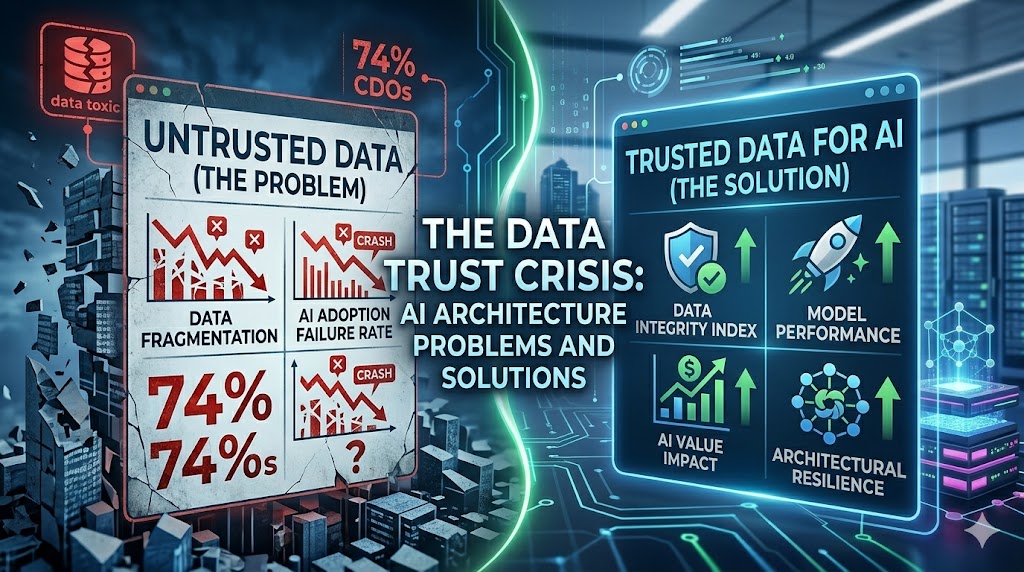
An IBM study published in 2025 surveyed 1,700 Chief Data Officers worldwide. Only 26% feel confident their organization’s data can support new AI-enabled revenue streams.
That number should stop you. Not because it describes a data quality problem — it describes an architecture problem. And architecture problems do not get solved by buying more tools or funding more AI projects.
What CDOs Are Actually Saying
When CDOs say they are not confident their data can support AI, they are usually not saying their data is wrong. They are saying their data is siloed, inconsistently governed, and built to answer questions their organization was asking five years ago.
Most enterprise data architectures were assembled application by application — a data mart here, a reporting database there, a Snowflake instance for the analytics team, a data lake for the data science team. Each system has its own metadata conventions, its own access controls, its own definition of what a “customer” or a “transaction” means. They all work. Individually.
The problem is that AI does not work individually. A language model, a recommendation system, or a forecasting pipeline needs to draw on data across these silos with consistent semantics. It needs to know that customer_id in the CRM means the same thing as cust_id in the billing system. It needs governance applied at the enterprise level, not at the system level. It needs an architecture designed for AI — not retrofitted for it after the AI roadmap is already funded.
Gartner’s 2025 forecast makes this concrete: 60% of AI projects will fail by 2026 not because the underlying models are wrong, but because the data feeding them is late, messy, or inconsistent.
The Distinction Executives Need to Understand
There is a useful distinction between having data and having AI-ready data.
Having data means you have information stored somewhere. Most enterprises have enormous amounts of it.
Having AI-ready data means:
- The same governance standards apply regardless of where data originates — the same rules in Redshift as in BigQuery as in the operational database
- Metadata is consistent and machine-readable across systems, not just within them
- Lineage is tracked: where did this record come from, how was it transformed, who has accessed it
- Access controls are policy-driven and enforceable programmatically — not managed through one-off agreements and manual reviews
- Data quality is measured and monitored continuously, not audited at quarterly review time
The difference is not primarily about tooling. It is about intentional architecture decisions made at the enterprise level, with executive sponsorship, before the AI use cases start demanding them.
Why This Is an Executive Decision, Not an Engineering One
Here is the trap organizations fall into: when an AI initiative fails because the data is not ready, the failure gets attributed to the initiative. The data infrastructure goes unexamined. The organization funds the next AI project and runs into the same problem twelve months later.
The IBM finding — 74% of CDOs not confident — suggests this pattern is widespread. Organizations are making AI investments at scale on top of data infrastructure that was not designed to support them.
Closing that gap cannot be delegated to the data engineering team. It requires an executive mandate to:
- Define a single standard for how data is governed, regardless of which system it lives in
- Invest in the foundations — unified metadata, consistent schemas, data quality pipelines — before prioritizing the next AI feature
- Reframe the timeline — AI readiness is a multi-year infrastructure program, not a project with a completion date
The organizations that make this investment now are building a compounding advantage. Every AI use case they attempt will have better raw material to work with. The ones that do not will continue funding initiatives on top of the same fragile foundations, wondering why the results fall short of the business case.
The Honest Read
The confidence gap among CDOs is real and it is structural. Closing it requires treating the data architecture as a first-class investment — not as supporting infrastructure for the AI projects everyone is excited about, but as the foundational decision that determines whether those projects can succeed.
If you want an honest assessment of whether your data architecture is ready to support the AI initiatives on your roadmap, request a consultation.