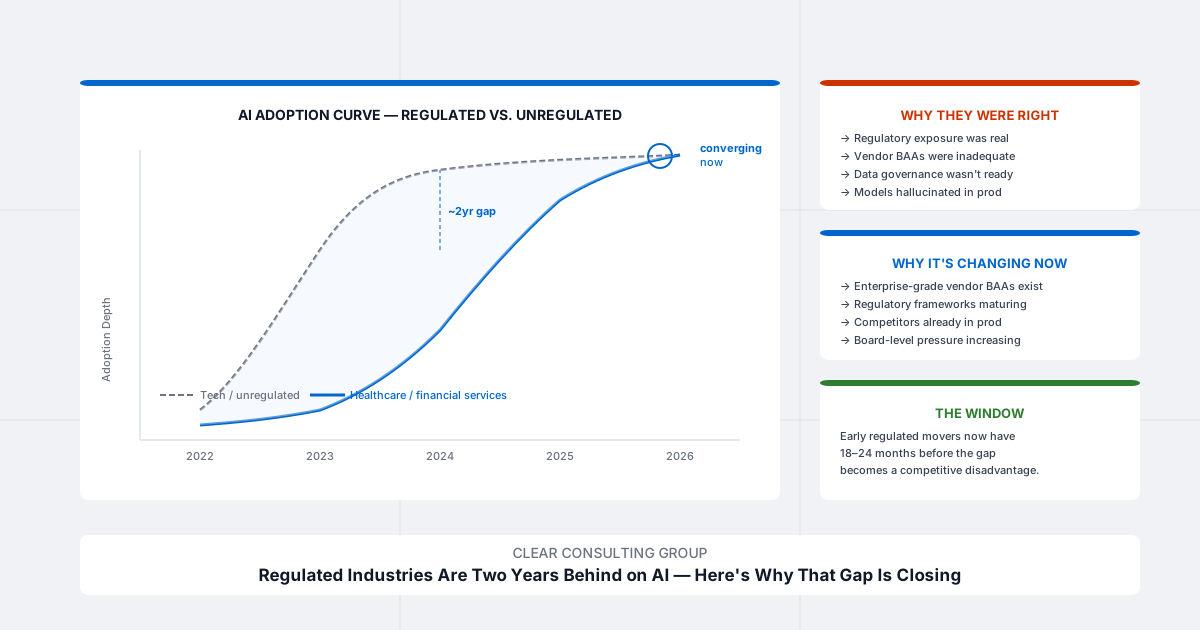
The story told about regulated industries and AI hasn’t been a flattering one. Healthcare systems moving too slowly. Banks paralyzed by compliance. Insurance companies holding meetings about meetings while startups ran circles around them. The implicit message: risk-aversion had become its own kind of risk.
There was something to that critique. But it left out a lot.
The truth is that many regulated-industry executives made a correct bet in 2023 and 2024, and they made it for the right reasons. The AI infrastructure that would have let them move faster simply wasn’t ready. The tools weren’t ready. The vendor agreements weren’t ready. The regulatory guidance wasn’t ready. The organizations that plunged ahead anyway are now discovering they built on sand.
That’s changing. The gap is real, it was rational, and it’s closing in ways that create a genuine window of opportunity for organizations that understand what actually shifted.
Why the caution made sense
Let’s be specific about what “not being ready” actually meant.
The vendor stack wasn’t enterprise-grade. In 2022 and early 2023, the AI vendors who mattered most didn’t have BAAs. OpenAI’s enterprise tier didn’t exist. Anthropic was API-only with no compliance documentation. The options for a healthcare organization that wanted to experiment with AI over clinical data were: build it yourself on a cloud provider you already had a HIPAA agreement with, or accept legal exposure. Most organizations made the sensible call.
The models hallucinated in ways that were clinically unacceptable. The failure modes of early LLMs in clinical contexts weren’t hypothetical — they were well-documented. Models would confidently generate wrong drug interactions, invent diagnostic criteria, and produce plausible-sounding nonsense. For a team trying to build something clinicians would actually trust and rely on, the reliability bar simply wasn’t there yet.
The regulatory guidance didn’t exist. Healthcare executives were being asked to make multi-year infrastructure investments in a technology whose regulatory treatment was entirely unresolved. HHS had published nothing specific on AI and HIPAA. The FDA’s approach to AI-enabled medical devices was in flux. Executives who wanted regulatory certainty before committing large budgets didn’t have anything to anchor to.
The internal data infrastructure wasn’t ready. AI systems are only as good as the data they’re built on. Most large health systems and financial institutions were still cleaning up governance issues from the previous decade — HL7 v2 interfaces, legacy EMR data with inconsistent schemas, core banking systems that nobody fully understood. Plugging a language model into that infrastructure is not a recipe for reliable outcomes.
Each of these issues was real. The organizations that paused weren’t wrong to pause.
What actually changed
The situation in 2026 is materially different across four dimensions.
Enterprise AI vendors now have real compliance infrastructure. OpenAI Enterprise, Anthropic Claude for Enterprise, Google Workspace with Gemini, Microsoft Azure OpenAI — these now come with proper BAAs, sub-processor disclosure, opt-outs from model training, and SOC 2 Type II reports. The compliance gap that blocked procurement in 2023 is largely closed for the major platforms. The risk has shifted to mid-tier vendors who are still catching up, which is a more manageable problem.
Model reliability has improved for well-scoped applications. The gap between what an LLM confidently states and what is actually true has narrowed substantially in constrained, well-defined tasks. Document summarization, structured data extraction, classification in defined schemas, code generation within narrow contexts — these are now reliable enough to build production systems on, with appropriate validation. The hallucination problem hasn’t disappeared, but it’s tractable in ways it wasn’t before.
Regulatory frameworks are materializing. HHS has issued AI guidance. The ONC has finalized rules around AI in clinical decision support. The SEC has published expectations around AI disclosures and supervisory controls. NIST has released AI risk management frameworks that regulators are starting to reference in examination guidance. These frameworks are imperfect and still evolving, but they exist. For an organization that needed a regulatory anchor before making serious investments, there’s something to anchor to now.
Competitors are in production. This one is uncomfortable, but it’s real. The health systems, insurers, and financial institutions that moved earlier are now running production AI systems for prior auth review, coding assistance, document processing, fraud detection, and customer-facing applications. Some of those systems were built too fast and will have problems. But many of them are working, and they’re creating efficiency advantages that compound month over month.
The window that’s actually opening
Here’s the dynamic worth understanding at a strategic level: the organizations that moved first built under serious constraint. They made architectural choices they’re now paying the price for — custom integrations to models that have been deprecated, fine-tuning approaches that don’t work well with newer architectures, compliance controls bolted on after the fact because they weren’t part of the original design.
Organizations starting now can start from better infrastructure, better vendor agreements, and better regulatory understanding. There’s a genuine first-mover advantage in having production experience — but there’s also something real in starting with a clean slate and building it right.
The window closes when the gap becomes a competitive liability rather than a strategic choice. For most regulated industries, that’s somewhere between 18 months and three years out, depending on the vertical and the specific use case. In healthcare revenue cycle and prior auth, it’s probably closer to 18 months. In clinical AI applications with direct patient impact, the window is wider because the validation requirements are steeper.
What this actually asks of executives
The organizations that will navigate this well aren’t the ones now panicking and approving everything at once. They’re the ones who can answer three specific questions clearly:
Which capabilities actually matter for your business model? Not “where can AI help,” but where does an AI-enabled capability create a durable competitive advantage or meaningfully reduce risk in your specific context? That’s a smaller list than the vendor presentations suggest.
Which vendors are genuinely ready for your compliance environment? This is not a box-checking exercise. It requires understanding the vendor’s sub-processor chain, their model training practices, their breach notification SLAs, and whether their security documentation is real or performative.
What order do you build in? The organizations that have scaled AI successfully in regulated environments did so incrementally — starting with use cases where the risk of a wrong answer is contained, building organizational confidence and capability, then expanding. The ones that stumbled tried to do too much at once.
The technology is no longer the hard part. The work is figuring out where to start, who to trust, and how to build organizational capability alongside the systems themselves.
That work requires judgment more than it requires urgency. Both, really — but judgment first.
The honest read
Regulated industries were right to be cautious about early AI adoption, and they’re right to be moving now. The variable that changed is the infrastructure, not the risk tolerance. The organizations that will do well in the next two years are the ones that can move with urgency and discipline at the same time — fast enough to close the gap, careful enough not to create the next wave of remediation work.
If you’re trying to figure out which AI investments make sense for your regulatory environment and how to sequence them, request a consultation.