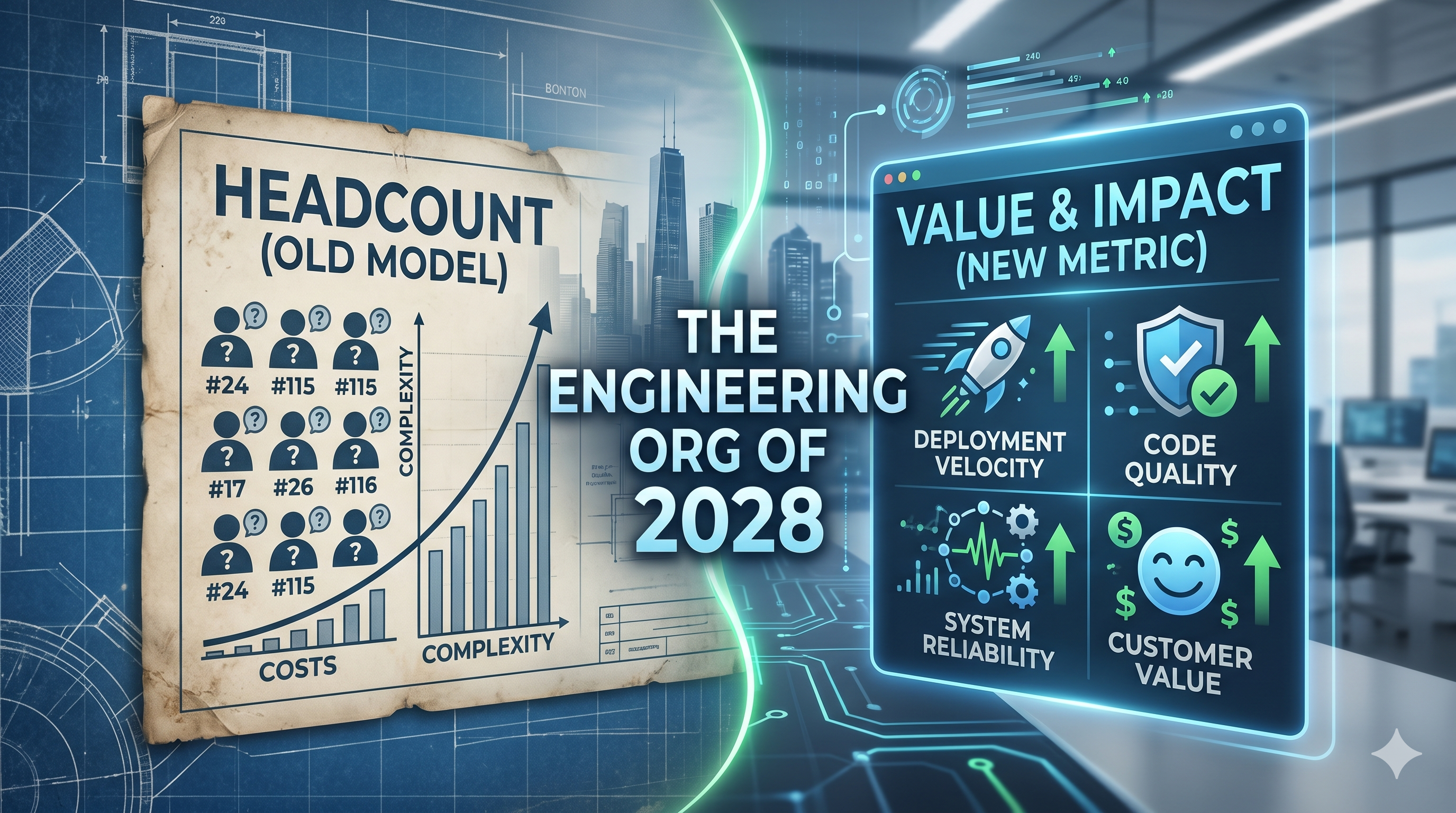
The Engineering Org of 2028: Why Headcount Is the Wrong Metric
The statistic getting the most attention is headcount. A 50-person engineering department in 2023 will likely become a 15-person department by 2027. One senior engineer, leveraged by AI agents, can do the work of a 5-person team. Junior developer employment for the 22–25 age cohort has already dropped nearly 20% from its 2022 peak.
These numbers are real. The frame is wrong.
Organizations that treat AI adoption in software engineering as a headcount reduction exercise are making a category error. The question isn’t “how many developers can we replace?” The question is “what does engineering capacity mean when the bottleneck is no longer code production?”
What Actually Changes
By early 2026, 46% of all code written by active developers comes from AI. Over 51% of commits to GitHub’s platform are AI-generated or substantially AI-assisted. The agentic shift is more significant than the autocomplete shift: tools like Claude Code, GitHub Copilot Agent Mode, and Cursor are executing multi-step workflows — planning, implementing, testing, opening pull requests — with minimal human input per cycle.
The engineering function is undergoing the same transformation manufacturing went through when automation arrived: the constraint shifts from production capacity to direction, quality assurance, and system design capacity.
A factory that replaced assembly workers with robots didn’t need fewer managers — it needed different managers. Engineers who could program the machines, define quality standards, and diagnose failure modes replaced engineers who ran the machines manually. Output went up. The skill mix changed entirely.
Software engineering is at that inflection point now.
The Three Organizational Redesign Questions
Executives asking the right question aren’t asking “how many engineers do we need?” They’re asking:
1. Who owns the specification layer?
When AI agents handle implementation, the quality of the output is a direct function of the quality of the input — the specifications, the context, the constraints. Organizations need to explicitly own this layer. In most companies today, it’s nobody’s job. Engineers write tickets or verbal instructions; agents interpret them; ambiguity propagates into production. The organizations pulling ahead are building specification disciplines — treating task definition as a core engineering competency, not an incidental step before the “real work” begins.
2. What does quality assurance mean at 4x velocity?
AI-assisted developers commit at 3–4x the rate of unassisted peers. Traditional code review cadences were designed around human production rates. An organization that doubled its AI tool adoption without redesigning its review practices has effectively degraded its quality controls by a factor of four. The answer isn’t “review everything manually” — that eliminates the productivity gain. The answer is automated gates (SAST, DAST, test coverage thresholds), structured review checklists specific to AI-generated code failure modes, and senior engineers whose primary value is adversarial review, not additional production.
3. What is the right ratio of senior-to-junior engineers in a world of AI agents?
Junior developer employment is down 20%. This is partly a market signal and partly an organizational choice. AI agents are already performing many of the tasks that junior developers historically handled — boilerplate, simple feature additions, test writing. But junior developers served another function: they became senior developers. The pipeline of future senior talent is thinning at exactly the moment when senior judgment is most valuable. Organizations that eliminate the junior layer entirely are borrowing against their own future engineering depth.
The Competitive Dynamics
The companies that get this right will have a durable advantage — not because they’ll have more engineers, but because they’ll have engineering capacity that scales with AI capability rather than headcount. Every improvement in underlying models translates directly into organizational output.
The companies that get it wrong will experience one of two failure modes:
The headcount trap: Reduce the team aggressively, ship more code, accumulate technical and security debt, discover the team is too thin to manage the debt when it surfaces.
The adoption lag: Keep the team size while competitors thin theirs, use AI tools as a productivity enhancement rather than a structural redesign, and find yourself in a cost structure that doesn’t reflect the market reality.
Neither is a winning position in regulated industries, where the cost of a security incident isn’t just remediation — it’s regulatory exposure, audit findings, and client trust. HIPAA, PCI-DSS, and SOC 2 environments don’t give you a “we moved fast” defense.
What the Transition Actually Requires
Three structural investments that most organizations haven’t made yet:
A spec writing discipline. This is the highest-leverage intervention in the entire stack. When the bottleneck shifts from code production to instruction quality, the organizations that invest in clear requirements processes — formal or informal — see compounding returns. This isn’t about adding bureaucracy; it’s about making the implicit explicit.
Governance-aware tooling selection. Not all AI coding tools are equivalent from a compliance standpoint. Audit trails, data residency, model versioning, and IP indemnification vary significantly across vendors. In regulated environments, tooling selection is a compliance decision, not just an engineering preference.
A senior talent retention strategy. The 15-person team of 2028 is entirely senior. That means the market for senior engineering talent gets tighter, not looser, despite the overall employment softness at the junior level. The organizations that treat the AI transition as a cost-reduction exercise and let senior talent walk are creating a strategic vulnerability they’ll feel in 2028.
The honest read
The 50-to-15 headline is a provocation, not a roadmap. The organizations building durable engineering advantage right now are treating AI adoption as an organizational design problem, not a labor arbitrage opportunity. What does your specification layer look like? Who owns QA at 4x velocity? How are you maintaining your senior talent pipeline? If you don’t have crisp answers to those three questions, you’re still working from the wrong frame.
If you want to work through what this transition looks like for your engineering organization — particularly in a regulated environment where quality and audit readiness aren’t optional — request a consultation.