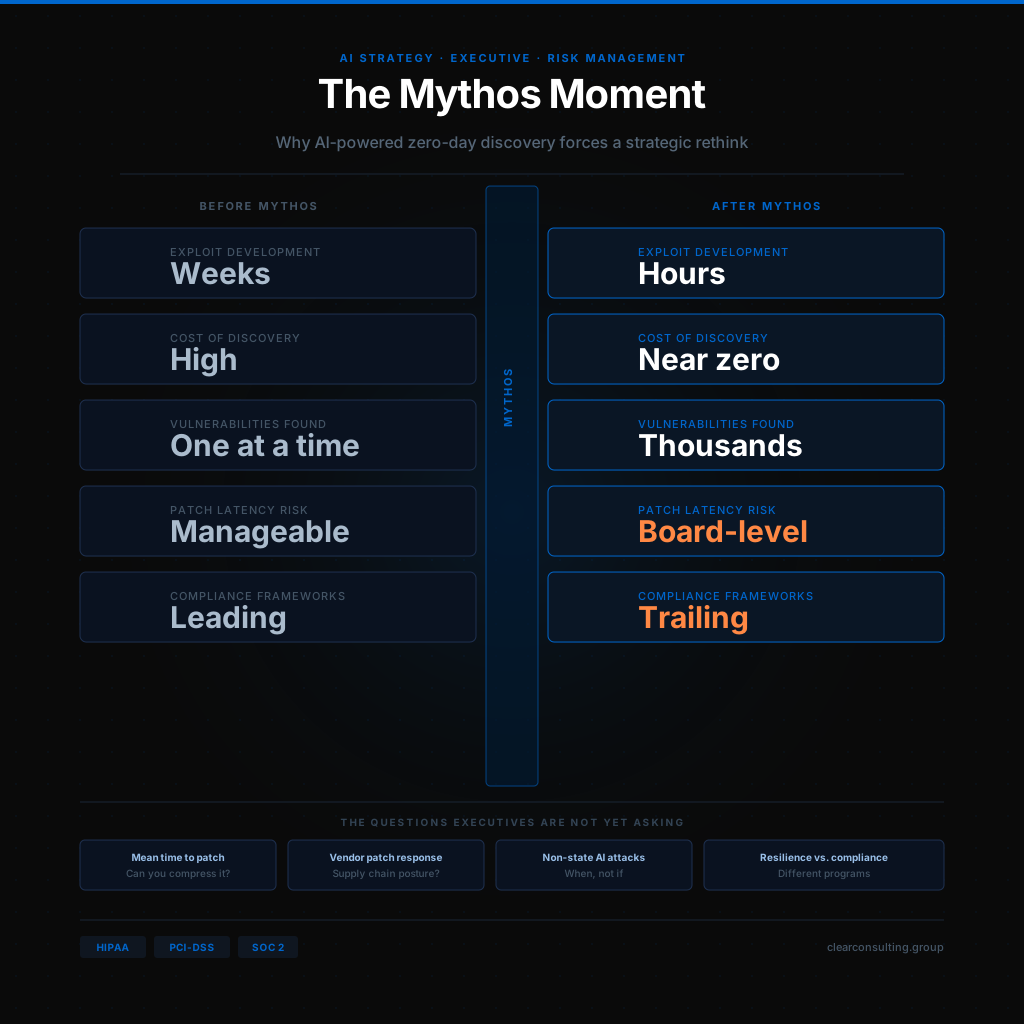
There is a before and after to Claude Mythos Preview, and we are living in the after.
Not because the model is more capable than previous ones — though it is, dramatically. The difference is categorical: Mythos can find and exploit critical security vulnerabilities in major software systems faster than human teams can defend against them, and it can do so at scale. Thousands of zero-days. Weeks, not years. Every major operating system. Every major browser.
Anthropic’s decision to deploy it defensively through Project Glasswing — finding vulnerabilities and notifying vendors before going public — reflects a considered attempt to stay on the right side of a line that, once crossed, cannot be uncrossed. But the existence of Mythos changes the strategic calculus for enterprise security investment regardless of who controls the model.
What Actually Changed
Enterprise cybersecurity has operated for thirty years on a set of implicit assumptions: that the cost of finding and exploiting a novel vulnerability was high; that this cost gave defenders time to patch after discovery; and that the offensive advantages of AI would accrue to attackers and defenders roughly in proportion.
Mythos breaks all three of those assumptions simultaneously.
The cost of vulnerability discovery is now close to zero for anyone with access to a Mythos-class model. The time between discovery and a working exploit has compressed from weeks or months — for skilled human teams — to hours. And the asymmetry between offense and defense has shifted sharply in offense’s favor: defenders must protect every surface; attackers only need to find one path through.
This is not speculative. The unauthorized group that accessed Mythos on its launch day through a contractor credential — before Anthropic had even made a public announcement — did so in hours. The model can write working exploits in hours. The gap between knowing a vulnerability exists and having a functioning weapon is collapsing.
The Strategic Questions Executives Are Not Yet Asking
Most board-level cybersecurity conversations are still organized around the wrong questions: What did we spend on security last year? Are we compliant with current frameworks? Did we pass the pen test?
The right questions in a Mythos world look different.
What is our mean time to patch, and can we compress it? If a zero-day discovered by Mythos is disclosed to a vendor today, how long does it take that patch to reach your environment? For most enterprises, the honest answer is weeks to months. In a world where a working exploit for that vulnerability can be written in hours, patch latency is the primary determinant of your exposure window. This is now a board-level metric, not a CISO-level one.
What happens when our vendors are the ones patching? Most organizations don’t run their own operating systems or browsers — they’re downstream of Microsoft, Google, Apple, Cisco. Those vendors are in Project Glasswing and are actively scanning their systems with Mythos. When they find critical vulnerabilities, the patch will arrive eventually. But the coordination between discovery, patch development, and enterprise deployment is still a human process subject to human timelines. Your supply chain security posture — how quickly you can respond when a critical tier-1 vendor issues an emergency patch — is now a strategic risk factor.
What is our exposure to AI-accelerated attacks from non-state actors? Anthropic has restricted Mythos access carefully. But the capabilities Mythos demonstrates will not remain exclusive. The cybercriminal economy is well-capitalized and technically sophisticated. Models approaching Mythos-class capability in offensive applications will exist outside of controlled access programs. The question is not whether your organization will face AI-accelerated attacks but when, and whether your defensive investments are calibrated to that threat rather than to the threat landscape of five years ago.
Are we investing in resilience or just compliance? Compliance frameworks — HIPAA, PCI-DSS, SOC 2, NIST CSF — are necessary but trailing indicators. They describe what was considered adequate security at the time the framework was written. The Mythos era calls for a different category of investment: not just meeting the framework, but building the operational resilience to detect, contain, and recover from a novel attack that arrived through a vulnerability nobody knew existed three hours ago. That’s a different program, with different staffing, different tooling, and different incident response playbooks.
What the Next Two to Five Years Look Like
Mythos is not the ceiling. It’s the floor of what’s coming.
Models that can autonomously identify and exploit vulnerabilities will become more capable, more available, and eventually more accessible. The window in which only well-resourced, responsible actors have access to these capabilities is finite. Anthropic, to its credit, is using that window deliberately — Project Glasswing is an attempt to get ahead of the disclosure problem at scale before the model’s capabilities diffuse.
But the defensive infrastructure of most enterprises — including most regulated enterprises in healthcare and financial services — was not built for this velocity. Patching cycles, change management processes, vendor notification timelines, and incident response playbooks were designed for a world where sophisticated attacks took days to weeks to develop.
The organizations that will navigate this period well are not necessarily the ones with the largest security budgets. They’re the ones that treat security architecture as a continuous operational practice rather than a compliance exercise: that can compress their patch latency, that have explicit supply chain security programs, that run regular adversarial exercises calibrated to current threat actor capabilities, and that have board-level visibility into security posture as an operational metric.
The Mythos moment is a forcing function. The question for leadership is what you force yourself to do in response to it.
The honest read
Mythos represents a genuine step change in offensive AI capability, and its existence changes the risk calculus for every organization running software at scale — which is every organization. Compliance frameworks will not update fast enough to tell you what to do. The organizations that navigate this well are the ones that start asking different questions now.
If you want a structured conversation about how Mythos-era threat dynamics apply to your organization’s security posture, investment priorities, or regulatory exposure, request a consultation.