There’s a seductive idea circulating in engineering teams right now: that if you train an AI model on your codebase long enough, it will absorb your team’s style, your patterns, your vibe — and start generating code that feels like yours.
This is vibe coding. And it works — until it doesn’t.
What Vibe Coding Gets Right (and Where It Breaks)
Vibe coding isn’t a straw man. It reflects something real: that AI models tuned on a team’s historical output can produce code that reads like a natural extension of existing work. Style consistency, idiomatic patterns, familiar abstractions — these are real benefits.
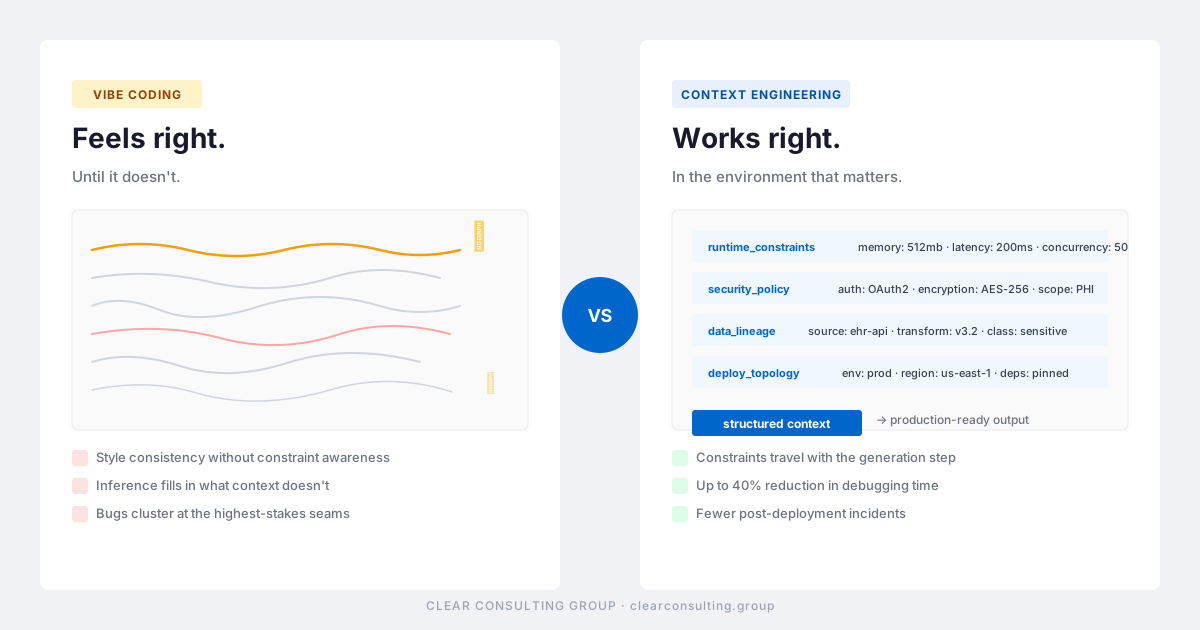
The problem surfaces when complexity enters the picture. A security policy that the model has never seen documented. A deployment topology that changed last quarter. A data lineage requirement that lives in a Confluence page no one thought to include in the training corpus.
At that point, the model is no longer working from knowledge — it’s working from inference. And in production environments, especially regulated ones, inference-based code generation is how you end up with a subtle authorization bug at 2 AM.
Vibe coding is karaoke night: everyone performs the same tune, and it sounds fine in the room. Whether the pitch is right for the recording studio is a different question.
What Context Engineering Actually Means
Context engineering starts from a different premise: that the quality of AI output is a direct function of the quality of the inputs you provide.
Not training. Context — the structured, runtime-relevant metadata you feed the model at the moment it generates code.
This means giving the model:
- Runtime constraints — memory limits, latency budgets, concurrency ceilings
- Security policies — auth requirements, encryption standards, compliance controls in force
- Data lineage — where data originates, what transformations it has undergone, what sensitivity classifications apply
- Deployment topology — what environment this code runs in, what it talks to, what dependencies are version-pinned
The analogy here isn’t karaoke. It’s a conductor’s score: every instrument knows exactly what it’s supposed to play, when, and at what volume. The result isn’t just more consistent — it’s correct in ways that matter.
The Practical Gap
The difference between these two approaches shows up at the seams — specifically, in debugging time and post-deployment incidents.
When a model generates code without structured context, mismatches between generated logic and production reality get discovered late. Sometimes in testing, often in production. The debugging overhead isn’t evenly distributed across the codebase; it concentrates in exactly the places where stakes are highest — integrations, auth flows, data pipelines.
Context engineering collapses that gap by moving production constraints upstream, into the generation step. Teams that have made this shift report material reductions in debugging time — in some cases up to 40% — and a measurable drop in post-deployment incidents. The root cause is structural: the model can’t generate code that violates a constraint it has been given.
What This Looks Like in Practice
For engineering leaders, the shift from vibe coding to context engineering is less about tooling and more about process discipline. Three things move the needle:
1. Embed domain-specific context early. Don’t treat context as something you assemble at generation time by hunting through documentation. Build the habit of maintaining structured context artifacts — security posture docs, architecture decision records, data contracts — in formats that can be injected reliably into AI workflows.
2. Automate context distribution. The constraint isn’t writing the context once; it’s ensuring the right context reaches the right generation step every time. This is a DevOps problem, not an AI problem. Treat it accordingly: version your context, validate it in CI, and fail fast when it’s stale or missing.
3. Use LLMs on top of the foundation, not instead of it. LLMs are extraordinary at synthesis and generation. They are not good at inferring constraints you haven’t given them. Separate these jobs clearly: structured context does the constraint work, the model does the generation work.
The Honest Read
Vibe coding produces fluent code. Context engineering produces code that works in the environment where it actually has to run. For greenfield prototypes and internal tools, that distinction may not matter much. For regulated systems — healthcare data pipelines, financial transaction processing, PCI-scoped eCommerce infrastructure — it’s the difference between a successful deployment and a costly incident.
The shift isn’t a wholesale replacement of the tools you’re using. It’s a discipline change in how you prepare before you prompt.
If you’re building AI-assisted development workflows and want to make sure the context engineering layer is solid — not just the LLM selection — request a consultation.